
Various Hair Extension Techniques - Which Techniques Are Trending
Brazilian sewn-in extension technique
How to apply weft extensions using the technique called Brazilian Stitch.
Unlike weave sewn onto a braid, in the Brazilian stitch, strands are sewn onto natural hair in small, pre-tied knots.

This technique generally takes between 1.5 and 2 hours.


What is a hair weave?
The weaving technique consists of sewing special hair wefts onto braids after they have been partially braided close to the scalp.

Weave extensions have a different application. In this case too, an expert's hand guarantees the best result. The extensions are applied as if they were "sewn". The hairdresser first makes a braid that adheres horizontally to the hairline, then joins the strands as if they were sewn.
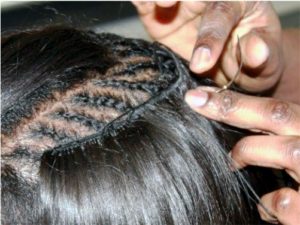
The result is natural and not obvious; it does not require the presence of keratin, silicone, glue or other substances, making the application delicate and minimally damaging to your hair, while being easy for the client to remove.
BRAZILIAN HAIR EXTENSION: Brazilian Piqué Lâché or Thread Extension.
The Brazilian attachment technique guarantees a very natural result. What does it consist of? Simple: extension strands are tied one by one to the natural hair, ensuring a seal of approximately three months. Provided, of course, that tailored maintenance is considered, starting with daily brushing (specific brushes are available online) to avoid knot formation, as well as careful and gentle cleaning. In this case too, it is necessary to call on a professional.

Brazilian thread extension is a form of hair extension that enhances women's beauty, thus increasing self-esteem. Called Brazilian piqué lâché, elastic thread is used in the attachment and therefore does not damage the hair strands.
To lengthen and add volume to hair, women use hair extensions as the best alternative for length or volume. Among many techniques, the Brazilian technique, little known in Europe, is widely used in Latin America because it gives a more natural look to the hair.
You must be wondering what differentiates thread extensions from other types of hair extensions, right?
Well, to start, the extension is done by attaching the strands with an elastic thread.
But what is elastic thread?
Elastic threads are sewing elastics that can be found in a similar color tone to the natural hair color that will be attached.

The Brazilian piqué lâché or thread extension uses the Brazilian technique which attaches the hair one by one by means of elastics.
Like all aesthetic procedures, thread hair extension must be performed by a professional who knows the technique and understands the procedure. Certain precautions must be taken so that the hair is not damaged.
Although elastic thread can be found in its original form in hair salons, the most suitable is the use of rubber thread or silicone thread, which can be found in specialized hair extension stores.
Thread hair extension or Brazilian piqué lâché can be applied with the following techniques:
1- Just a few strands: applied to add volume or cover imperfections;
2- Strand by strand in the middle of the head: applied to the sides and nape, the strands give more volume and length;
3- Strand by strand all over the head: applied to almost all the hair. Ideal for lengthening short hair and creating a lot of volume.
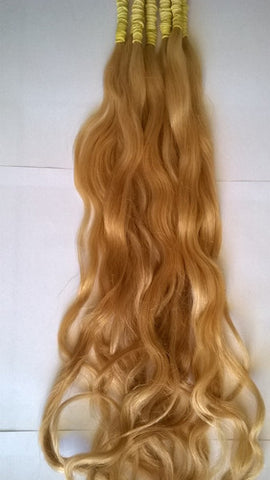

But in the end, can everyone get thread extensions?
Yes, thread hair extensions or Brazilian piqué lâché can be used by all women. Because it is suitable for all hair types. Many hairdressers believe that this technique is excellent for afro hair, because the elastic gives more resistance to the application. Others advise it to clients who need more volume, as the strands are larger.
But a good professional knows how to dose the quantity of strands in relation to the volume of his client's hair.
Are there any contraindications to this Brazilian technique?
In fact, there are no contraindications. But as the technique requires greater contact with the scalp, some hairdressers prefer not to use it on clients with hypersensitivity to the scalp, thus avoiding possible discomfort.
How is the maintenance of this technique carried out?
Above all, the maintenance of thread extensions takes place between the second or fourth month after application. During maintenance, the elastics are cut so that the extension strands and the client's hair are prepared for a new application, if necessary.

It is important to be aware that there are special care steps that must be taken every week to keep hair and extensions beautiful and healthy.
However, to keep your hair always shiny and beautiful, we list below all the care to take for the maintenance of your thread extensions:
Discover them below
1- Keep the root clean and dry;
2- Brush your hair carefully, remembering to use the special brush for the scalp, the paddle-shaped one;
3- Never use fine combs;
4- Moisturize hair every 15 days;
5- Perform necessary maintenance in the salon;
6- Be careful with excessive use of hair dryer and straightener;
7- Shampoo, conditioner or repairing mask can be the same as used, avoiding oiliness. However, for those with oily roots or dandruff, it is recommended to use two types of shampoos, one specific for the root and the other for extensions;
* When washing hair, stick to scalp care by massaging it with light circular movements;
* Always detangle the strands with the paddle brush when washing hair;
After beaches, sunbathing or swimming pools, we must pay special attention to extensions. Here are some tips:
1- Make sure the root does not stay wet for a long time;
2- Use a specific sun protector for hair or leave-in;
3- Tying hair up is a way to prevent it from breaking; a braid is the most recommended by hairdressers, as it does not strain the root;
What other observations?
Please note that these same precautions can be applied when practicing outdoor activities.
As a technique that does not require glue or keratin during application, nor chemicals during removal, the Brazilian thread extension technique has been considered a natural technique and for this reason, it is the least harmful among other hair extension methods.
In addition, another advantage of the Brazilian piqué lâché is that during application, no intense heat process is used, which makes this type of hair extension more natural.
In summary, it is important to note that the Brazilian technique can be applied to all hair lengths: short, medium and long. Whether it's damaged, brittle, with excessive hair loss or even healthy, fine or thick hair that needs more volume or more length.

Although the Brazilian thread extension technique is highly recommended for afro hair. This technique is widely applied and looks great on natural straight blonde hair and hair straightened with chemicals (Brazilian straightening or relaxer).
Warning: remember to consult a professional you trust. Before deciding on the technique you want to use to lengthen your hair!
No matter what type of hair you have. What really matters is your desire to change and renew your look.
If you decide to use Brazilian piqué lâché, the thread extension as a technique for your extensions. Even if for a determined time or long term, remember that the secret to keeping your hair beautiful, shiny and healthy is to preserve the health of the strands and scalp. Weekly maintenance is essential for this.
To remove extensions applied with these methods, it is always better to trust a hairdresser. Keratin extensions must be removed with a product and pliers before the hair is washed.